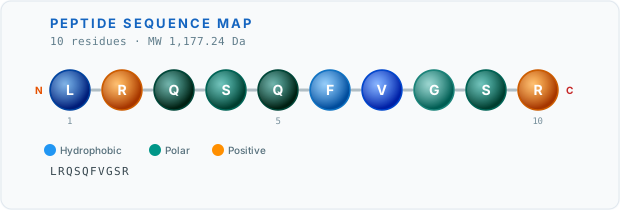
![[Gly11] Substance P — Peptide Sequence Visualization](https://bostonmolecules.com/wp-content/uploads/peptide-sequences/peptide-seq-6513.svg)
[Gly11] Substance P
Price range: $51.85 through $311.10
[Gly11] Substance P
[Gly11] Substance P is a 13-amino-acid A peptide related to the tachykinin/substance P family, an 11-amino-acid neuropeptide that signals through NK1 receptors to mediate pain transmission, inflammation, emesis, and neurogenic vasodilation. Widely used in pain, inflammation, and neuroscience research for studying nociception, neurogenic inflammation, and the development of NK1 receptor antagonists (e.g., aprepitant for chemotherapy-induced nausea).
Product Specifications
| Molecular Weight | 1273.4816 Da |
| Molecular Formula | C₆₀H₉₂N₁₈O₁₃ |
| Purity | Peak Area by HPLC ≥95% |
| Form | Lyophilized |
| Storage | -20°C |
| Usage | Research use |
Amino Acid Sequence
One-Letter Code:
RPKPQQFFGLG-NH2
Three-Letter Code:
H-Arg-Pro-Lys-Pro-Gln-Gln-Phe-Phe-Gly-Leu-Gly-NH2
Research Applications
- Application: Receptor binding
- Biomarker Target: Neurokinin Receptors (NK1-3R)
- Research Area: Neuroscience
- Sub-category: Tachykinin Signaling & Pain
Reconstitution & Storage
- Reconstitution: Reconstitute in sterile water or appropriate buffer to desired concentration.
- Storage: Store lyophilized product at -20°C. After reconstitution, aliquot and store at -20°C to -80°C. Avoid repeated freeze-thaw cycles.
- Stability: Lyophilized product is stable for 24 months when stored properly.
For research use only. Not for diagnostic or therapeutic use.
Safety Data Sheets & Documentation
Protocols & Support
Reconstitution Protocol
1. Briefly centrifuge the vial to collect lyophilized powder at the bottom.
2. Reconstitute in sterile deionized water or PBS to a concentration of 0.2–1.0 mg/mL.
3. Gently pipette up and down to dissolve. Do not vortex.
4. Aliquot and store at -20°C to -80°C. Avoid repeated freeze-thaw cycles.
Download Data Sheet
Complete product data sheet including batch-specific QC data, sequence information, and storage guidelines.
Download PDF Data Sheet
![[Gln11]-β-Amyloid (1-28)](https://bostonmolecules.com/wp-content/uploads/peptide-sequences/peptide-seq-5670.svg)