RGD Peptide
Price range: $99.00 through $346.50
RGD Peptide
RGD Peptide is a synthetic tripeptide corresponding to the minimal cell recognition sequence found in extracellular matrix proteins such as fibronectin, vitronectin, and fibrinogen. It functions as a ligand for the integrin family of transmembrane receptors—including αvβ3, α5β1, and αvβ5 subtypes—mediating cell adhesion, migration, proliferation, and survival signaling. Widely utilized in tissue engineering, targeted drug delivery, molecular imaging, and the functionalization of hydrogels, scaffolds, and nanoparticle systems.
Product Specifications
| CAS Number | 99896-85-2 |
| Molecular Weight | 346.34 Da |
| Purity | Peak Area by HPLC ≥95% |
| Form | Lyophilized |
| Storage | -20°C |
| Usage | Research use |
Amino Acid Sequence
One-Letter Code:
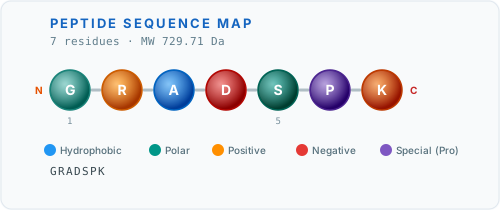
Arg-Gly-Asp
Three-Letter Code:
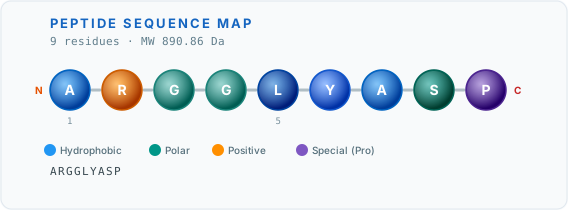
H-Ala-{D-Arg}-{D-Gly}-Gly-{D-Leu}-{D-Tyr}-Ala-{D-Ser}-{D-Pro}-OH
Research Applications
- Application: Cell adhesion
- Biomarker Target: Integrin Receptors (αvβ3, α5β1)
- Research Area: Cell Biology
- Sub-category: Integrin Signaling & Cell Adhesion
Reconstitution & Storage
- Reconstitution: Reconstitute in sterile water or appropriate buffer to desired concentration.
- Storage: Store lyophilized product at -20°C. After reconstitution, aliquot and store at -20°C to -80°C. Avoid repeated freeze-thaw cycles.
- Stability: Lyophilized product is stable for 24 months when stored properly.
For research use only. Not for diagnostic or therapeutic use.
Safety Data Sheets & Documentation
Protocols & Support
Reconstitution Protocol
1. Briefly centrifuge the vial to collect lyophilized powder at the bottom.
2. Reconstitute in sterile deionized water or PBS to a concentration of 0.2–1.0 mg/mL.
3. Gently pipette up and down to dissolve. Do not vortex.
4. Aliquot and store at -20°C to -80°C. Avoid repeated freeze-thaw cycles.
Download Data Sheet
Complete product data sheet including batch-specific QC data, sequence information, and storage guidelines.
Download PDF Data Sheet