Mouse RANKL Recombinant Protein (HEK293 Expression) — Tag Free
Price range: $198.00 through $5,600.00
 HEK293 × Chaperone-Assisted Technology
Produced using our proprietary Z-Active® platform — HEK293 mammalian expression with chaperone-assisted folding for proper disulfide bonding, N-linked glycosylation, and 5–10× higher bioactivity vs Leading Suppliers.
Overview
TRANCE (receptor activator of NF-kappa B ligand [RANK L], also called TNF-related activation-induced cytokine [TRANCE], osteoprotegrin ligand [OPGL], and osteoclast differentiation factor [ODF]), is a member of the tumor necrosis factor (TNF) family. TRANCE was originally identified as an immediate early gene up-regulated by T cell receptor stimulation. The mouse TRANCE cDNA encodes a type II transmembrane protein of 316 amino acids with a predicted cytoplasmic domain of 48 amino acids and an extracellular domain of 247 amino acids. The extracellular domain contains two potential N-linked glycosylation sites. Mouse and human TRANCE share 85% amino acid identity. TRANCE is primarily expressed in T cells and T cell rich organs, such as thymus and lymph nodes. The multi-functions of TRANCE include induction of activation of the c-jun N-terminal kinase, enhancement of T cell growth and dendritic cell function, induction of osteoclastogenesis, and lymph node organogenesis. RANK is the cell surface signaling receptor of TRANCE. RANK has been shown to undergo receptor clustering during signal transduction. Osteoprotegrin, a soluble member of the TNF receptor family which binds TRANCE, is a naturally occurring decoy receptor that counterbalances the effects of TRANCE.
Specifications
- Species: mouse
- Expression System: HEK293
- Sequence: Lys158-Asp316
- Tag: Tag Free
- Molecular Weight: 17.8 KDa
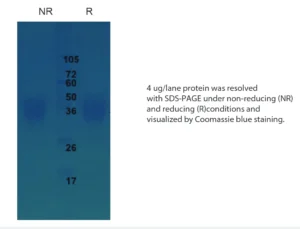
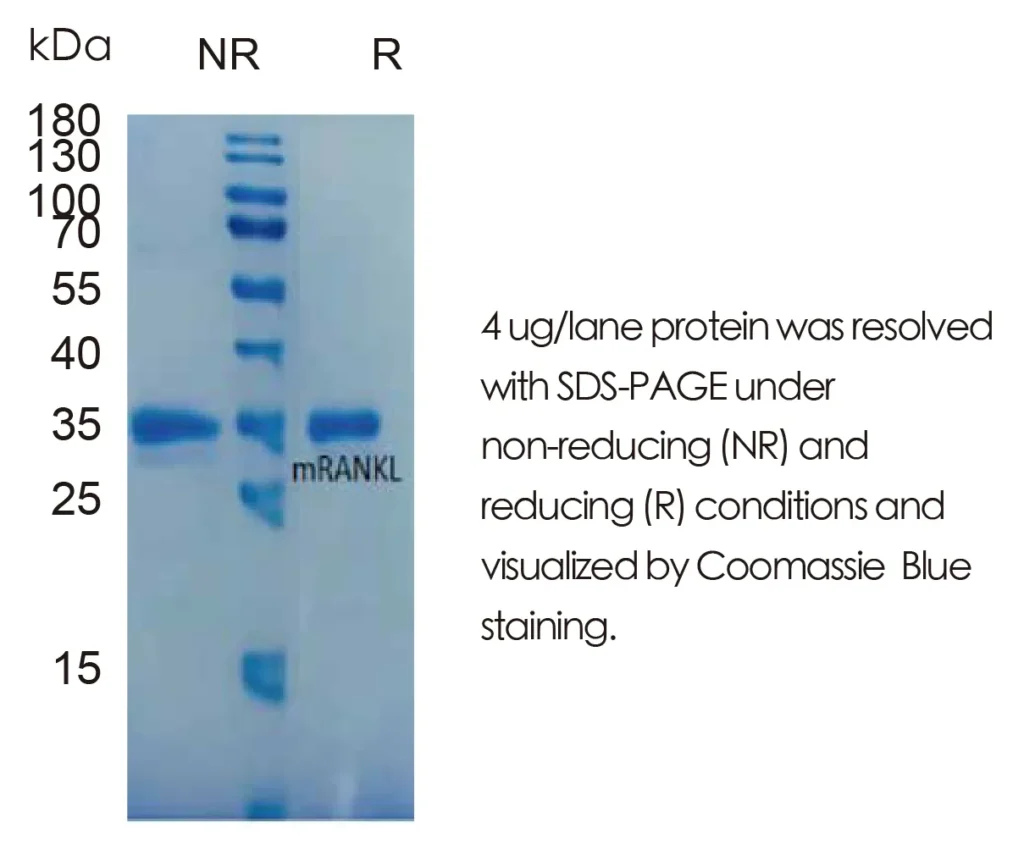
- Purity: > 95% by Tris-Bis PAGE;> 95% by SEC-HPLC
- Endotoxin: < 1 EU/μg of the protein by LAL method.
- UniProt/Swiss-Prot: O35235
- Available Sizes: 10 µg, 50 µg, 1 mg
Bioactivity
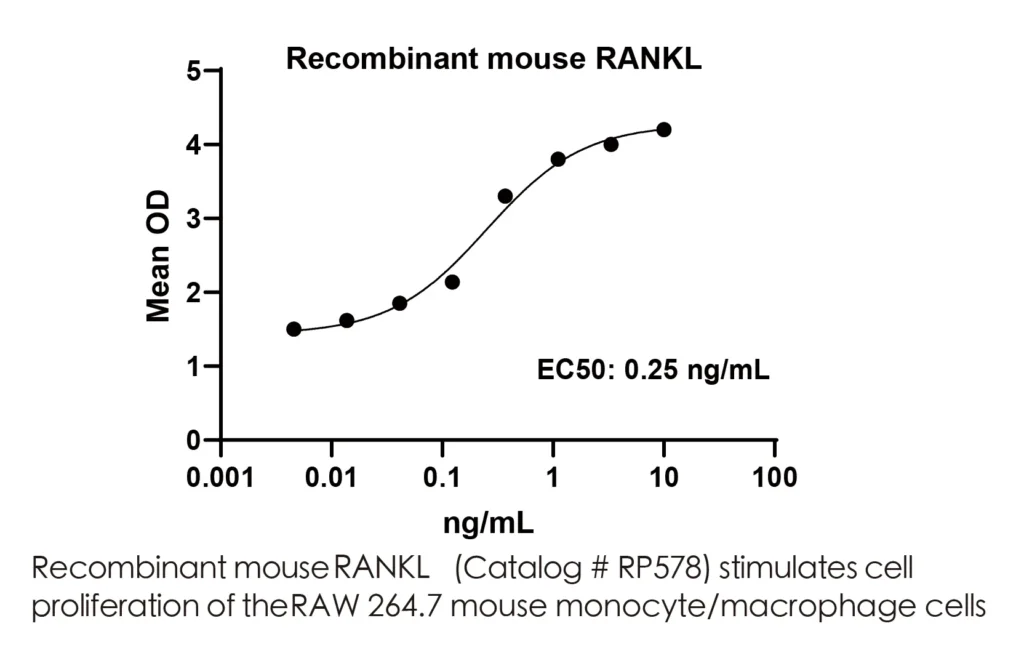
Measured by its ability to induce osteoclast differentiation of RAW 264.7 mouse monocyte/macrophage cells. The ED50 for this effect is 0.5‑2 ng/mL.
Formulation & Reconstitution
Formulation: 0.22 μm filtered solution of PBS, pH 7.4.
Reconstitution: 0.2 mg/mL in sterile PBS, pH7.4
Storage & Stability
Aliquot and store at -80°C. Avoid repeated freeze/thaw cycles.
Quality Assurance
Each lot is tested for purity (SDS-PAGE, SEC-HPLC), endotoxin levels (LAL method), and bioactivity. A Certificate of Analysis (COA) is provided with every order.
Safety Data Sheets & Documentation
Protocols & Support
Reconstitution Protocol
1. Briefly centrifuge the vial to collect lyophilized powder at the bottom.
2. Reconstitute in sterile deionized water or PBS to a concentration of 0.2–1.0 mg/mL.
3. Gently pipette up and down to dissolve. Do not vortex.
4. Aliquot and store at -20°C to -80°C. Avoid repeated freeze-thaw cycles.
Download Data Sheet
Complete product data sheet including batch-specific QC data, sequence information, and storage guidelines.
Download PDF Data Sheet